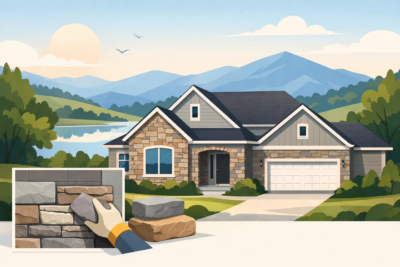

A plain front elevation can make even a well-built home feel unfinished. Stack stone veneer changes that impression quickly, adding layered texture, shadow, and architectural weight where a home needs a stronger focal point. Used with intention, it can make an entry feel more welcoming, give a chimney real presence, or turn an ordinary fireplace wall into the feature that anchors a room.
For homeowners across the Shenandoah Valley, stack stone is especially appealing because it works with a range of familiar home styles. It can complement a new farmhouse, sharpen a traditional colonial façade, warm up a craftsman porch, or add contrast to a clean-lined contemporary renovation. The key is not simply choosing a stone color you like. It is choosing a profile, scale, and placement that belong to the house.
What Gives Stack Stone Its Distinct Look
Stack stone veneer is made up of narrow, horizontally oriented stones set in layered courses. Compared with rounded field stone or the more formal faces of cut stone, it has a linear character. That horizontal movement makes a wall feel grounded and substantial while the varied depths catch light throughout the day.
The profile can feel rustic, tailored, or somewhere between the two. Some stack stone selections have crisp edges and relatively consistent heights for a more refined appearance. Others include greater variation in length, thickness, and surface texture, creating a more natural, hand-laid look. Neither approach is automatically better. A carefully detailed new build may benefit from cleaner lines, while a home with timber details, board-and-batten siding, or a wooded setting may call for more texture.
Manufactured veneer offers another practical advantage: it provides the appearance and depth of stone without requiring the structural support associated with full-bed natural stone. That makes it a smart option for many exterior upgrades and interior remodels, provided the substrate, flashing, and installation details are handled correctly.
Where Stack Stone Makes the Biggest Difference
Stack stone has the most impact when it is used to emphasize an architectural feature rather than applied everywhere without a plan. A well-placed stone accent gives the eye a place to land and helps the home read as a complete composition.
Entryways and porch columns
The front entry is often the best place to begin. Wrapping the lower portion of porch columns or building stone bases beneath wood posts introduces texture at eye level and gives lighter exterior materials a stronger foundation. On homes with a covered porch, stack stone can tie the entry to a nearby chimney, foundation accent, or retaining wall.
Proportion matters here. A small porch can be overwhelmed by heavy stone columns, while tall columns with only a narrow stone base can look disconnected. The goal is a balanced transition from the ground to the porch roof, not a decorative afterthought.
Chimneys and exterior walls
A chimney naturally asks for a material with permanence. Stack stone veneer is an effective choice for a full chimney surround, particularly when the chimney is visible from the street or extends above the roofline. It also works well on a bump-out, gable accent, or one carefully selected section of the front façade.
For a broad wall, consider the view from the road as well as the view from nearby. Small-scale stone can look busy when used across a large uninterrupted surface. A profile with longer pieces or a calmer color blend often reads better at distance. On the other hand, a more textured profile can add welcome character to a modest chimney or compact entry wall.
Fireplaces and interior feature walls
Inside, stack stone brings the same sense of depth without requiring an entire room to be rebuilt. A fireplace surround is the classic application, but it is not the only one. It can define a dining-room wall, frame an open stairway, or create a memorable backdrop in a finished basement.
Interior placement calls for restraint. Stone already carries visual texture, so pair it with simpler finishes nearby. Smooth painted walls, wood mantels, black metal details, and uncluttered furnishings let the stone remain the focal point. If the room has low ceilings, a lighter color range and a fireplace design that emphasizes vertical height can keep the space from feeling closed in.
Foundations, garden walls, and outdoor living areas
A foundation skirt can make a home appear anchored to its site, especially where siding meets a visible concrete foundation. Stack stone can also carry a house’s exterior character into an outdoor kitchen, seating wall, or fireplace area. Repeating the same stone in these locations creates continuity, but the application should still suit the setting. A busy façade paired with a heavily veneered patio can become visually crowded.
Choosing a Stack Stone Color That Belongs
Color is usually the first decision homeowners make, but it should not be made in isolation. Bring the roof, siding, trim, brick, mortar, and surrounding landscape into the conversation. A stone sample may look one way indoors and entirely different against a house in morning sun, afternoon shade, or wet weather.
Warm blends with browns, tans, and soft grays often pair naturally with cedar tones, cream siding, bronze windows, and traditional exterior palettes. Cooler grays can look sharp alongside white, charcoal, black, or blue-gray siding. Multi-color blends offer flexibility, but they need a clear supporting palette. If a stone contains warm and cool tones, choose trim, doors, and metal accents that reinforce one direction rather than adding another competing color.
It also helps to consider what will not change soon. Roof color, window frames, and existing brick are expensive to replace, so they should guide the stone selection. A front door can be repainted later. Stone should work with the permanent parts of the home first.
Details That Keep the Project From Looking Pieced Together
The difference between a stone accent and a finished architectural feature often comes down to the edges. Stone needs a purposeful beginning and ending. That may mean coordinating a wall cap, pier cap, hearth, sill, or keystone so the project feels designed rather than abruptly stopped.
For example, a stack stone column looks more complete when it is topped with a properly scaled cap. A mailbox or address marker can become part of the same design language when it uses coordinated street numbers or stone details. Around a fireplace, the mantel, hearth, and stone termination should be considered as one composition.
Grizzly Stone helps homeowners and building professionals think through these finishing components alongside the veneer selection. That approach is especially useful when a project includes several visible elements, such as an entry column, a chimney, and a foundation accent. Matching does not have to mean repeating every material everywhere. It means the pieces look like they were chosen for the same home.
Installation Is Part of the Finished Appearance
A beautiful stone profile cannot compensate for poor preparation or weak installation work. Exterior veneer needs the right wall system, moisture management, flashing, drainage provisions, and properly prepared substrate. Corners, openings, transitions, and the point where stone meets another cladding material deserve particular attention because those are the areas most likely to reveal shortcuts.
Homeowners should also ask how the installer plans to handle patterning. Stack stone should not develop obvious repeating joints, long straight seams, or clusters of identical pieces. A skilled mason or veneer installer varies lengths and depths naturally while maintaining the horizontal character that makes the profile attractive.
For new construction, selecting stone early helps builders coordinate framing details, exterior trim, lighting, and caps. For a remodel, careful measurement and product planning prevent a partial project from ending with awkward cuts or mismatched transitions. An estimate should account for waste, corners, accessories, and the full scope of the visible finish, not just the square footage on the wall.
How Much Stack Stone Is Enough?
More stone does not always create a better home. On a simple ranch or modest two-story house, a chimney and entry accent may be all that is needed to create curb appeal. On a larger home with multiple elevations, stone can be carried across foundation sections and columns to establish rhythm without covering every surface.
Think of stack stone as an architectural punctuation mark. It should emphasize the parts of the home that deserve attention: the entrance, the hearth, the chimney, or the transition into an outdoor living space. When stone, siding, trim, and finishing details are balanced, the result feels established from the day the project is completed.
The best next step is to look at your home from the street, then from the places where your family actually spends time. The right stack stone application will improve both views and give the house a more lasting sense of place.